
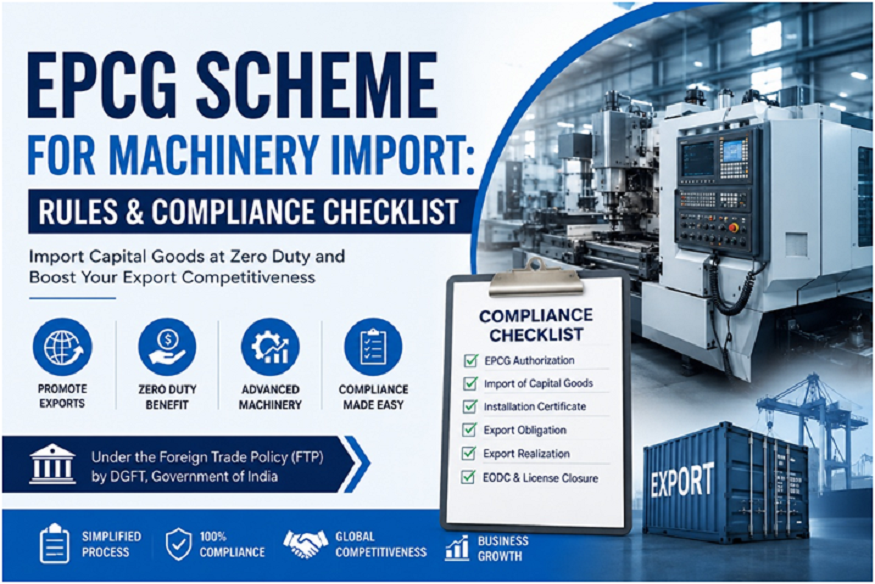
The Export Promotion Capital Goods (EPCG) Scheme is one of India’s most important export promotion initiatives for manufacturers and exporters looking to import machinery at reduced or zero customs duty. Introduced under the Foreign Trade Policy (FTP) by the Directorate General of Foreign Trade, the scheme helps businesses modernize production facilities while improving export competitiveness.
For industries investing in imported machinery, CNC equipment, industrial automation systems, production lines, testing equipment, or specialized manufacturing technology, the EPCG Scheme can significantly reduce upfront capital costs. However, the benefits come with strict compliance requirements and export obligations.
This guide explains the key EPCG rules for machinery import along with a practical compliance checklist businesses should follow.
What Is the EPCG Scheme?
The EPCG Scheme allows eligible businesses to import capital goods for pre-production, production, and post-production at zero customs duty, subject to fulfillment of export obligations within a specified period.
The objective of the scheme is to help Indian exporters upgrade technology and improve manufacturing quality while increasing exports from India.
Eligible capital goods include:
- Industrial machinery
- Manufacturing equipment
- CNC machines
- Packaging machinery
- Testing and quality control equipment
- Refrigeration and power generation equipment
- Moulds, dies, jigs, fixtures, and tools
- Computer systems and production software
- Spares and catalysts in specified cases
The scheme also permits import of second-hand machinery without age restrictions in many cases.
Who Can Apply for EPCG Authorization?
The following entities can apply for EPCG benefits:
- Manufacturer exporters
- Merchant exporters tied to supporting manufacturers
- Service providers
- Hotels, hospitals, logistics companies, and other eligible service sectors
To apply, businesses must possess:
- Valid IEC (Import Export Code)
- GST registration
- RCMC certificate
- Digital Signature Certificate (DSC)
- Proper export documentation records
Key Rules for Machinery Import Under EPCG
1. Machinery Must Qualify as Capital Goods
Only machinery and equipment directly linked to production, export services, or operational processes are eligible under EPCG.
The imported machinery should have a clear nexus with the export product or service.
For example:
- Textile machinery for garment exports
- Food processing equipment for processed food exports
- CNC machinery for engineering exports
2. Export Obligation Is Mandatory
The biggest condition under EPCG is the Export Obligation (EO).
Businesses must fulfill exports equivalent to multiple times the duty saved value within the prescribed period. Typically, the export obligation is:
EO=6×Duty Saved Value
The export obligation period is generally six years from authorization issuance.
3. Average Export Obligation Must Be Maintained
In many cases, companies must also maintain their average export performance achieved in previous years in addition to fulfilling specific export obligations.
Failure to maintain average exports can create compliance complications.
4. Machinery Installation Is Mandatory
Imported machinery must be installed at the declared premises within the prescribed period.
An Installation Certificate must be obtained from:
- Independent Chartered Engineer
- Or designated customs authority
The certificate must be submitted to DGFT within the specified timeline.
5. EPCG Authorization Must Be Registered With Customs
Before clearing imported machinery duty-free, the EPCG authorization must be registered at the port of import with customs authorities.
6. Machinery Cannot Be Freely Sold or Diverted
Capital goods imported under EPCG are subject to actual user conditions.
The machinery generally cannot be:
- Sold
- Transferred
- Leased
- Shifted improperly
until export obligations are fulfilled and the authorization is redeemed.
Documents Required for EPCG Machinery Import
Typical documentation includes:
- IEC certificate
- GST registration
- RCMC certificate
- PAN card
- DSC registration
- Proforma invoice of machinery
- Technical specifications
- Chartered Engineer certificate
- CA certificate for export turnover
- Manufacturing process details
- Nexus justification for machinery and export product
EPCG Compliance Checklist for Importers
Here is a practical compliance checklist businesses should follow after obtaining EPCG authorization.
Before Import
Verify Eligibility
- Confirm machinery qualifies as capital goods
- Ensure export product linkage is valid
- Check applicable FTP provisions
Prepare Documentation
- IEC and GST details updated
- RCMC active
- DSC functional on DGFT portal
- Technical literature ready
Review Export Capacity
Before applying, businesses should realistically evaluate whether they can fulfill the required export obligation within six years.
During Machinery Import
Register EPCG Authorization at Customs
- Register license at designated port
- Execute bond or bank guarantee if required
Ensure Correct Documentation
- Match invoice value with authorization
- Verify HSN classification
- Maintain Bill of Entry records
Track Duty Saved Amount
Maintain accurate records of customs duty exemptions because export obligation calculations depend on the actual duty saved value.
After Machinery Installation
Obtain Installation Certificate
The certificate should include:
- Machinery details
- Serial numbers
- Installation address
- Operational status
- Date of commissioning
Submit Installation Proof to DGFT
Delayed submission may require condonation procedures and additional fees.
Export Obligation Monitoring
Maintain Export Records
Keep organized records of:
- Shipping bills
- e-BRCs
- Export invoices
- Foreign remittance proofs
Mention EPCG Authorization Number in Shipping Bills
Exports may not be counted toward export obligation fulfillment if the EPCG authorization number is missing from export documents.
Monitor Block-Wise Export Targets
Businesses should periodically review progress against export obligations instead of waiting until the final deadline.
Redemption & Closure
After fulfilling export obligations:
- Apply for Export Obligation Discharge Certificate (EODC)
- Submit all export evidence
- Obtain closure from DGFT
- Release customs bond/bank guarantee
Proper closure is important to avoid future disputes or penalties.
Common EPCG Compliance Mistakes
Many businesses face penalties because of avoidable compliance failures such as:
- Delay in machinery installation
- Incorrect export documentation
- Missing EPCG number on shipping bills
- Poor export tracking
- Failure to maintain average export obligation
- Improper machinery transfer
- Delayed EODC application
Non-compliance may result in recovery of saved customs duty along with interest and penalties.
Final Thoughts
The EPCG Scheme is highly beneficial for manufacturers and exporters importing advanced machinery into India. It helps reduce capital investment costs, improve manufacturing capability, and increase export competitiveness.
However, EPCG is not just an import benefit scheme — it is a long-term compliance commitment. Businesses planning to import machinery under EPCG should carefully evaluate export potential, documentation systems, and compliance readiness before applying.
With proper planning and record management, companies can successfully leverage EPCG benefits while avoiding penalties and regulatory complications.